You look at your website and sigh. Maybe it feels a bit dated. Maybe your contact form is quieter than you’d like. Your first instinct might be that you need a whole new site, but before you panic, let’s talk about it. Not every business needs a full small business website redesign. In fact, many local sites are just a few simple content fixes away from doing their job properly.
This post is your casual guide to figuring out if you need a full rebuild or just a tune-up. We’ll walk you through our quick five-minute test to see where you stand. Then, we’ll look at what a content refresh really demands versus the time and money involved in a full rebuild. We’ll also cover three signs that a rebuild is actually the cheaper choice in the long run and give you a side-by-side comparison. By the end, you’ll have a clear picture and a plan for finding website design help without the big-agency price tag. Let’s find your next three moves.
Two Very Different Ways to Fix a Website
Most owners land here after one too many enquiries have gone quiet, and the first instinct is that the whole site has to go. In our experience at Epik Monkey, that’s usually not what’s happening. Most local business sites don’t have a broken foundation; they have a content problem. That’s our position from working with local clients, not an industry statistic.
So let’s define the two options in plain English.
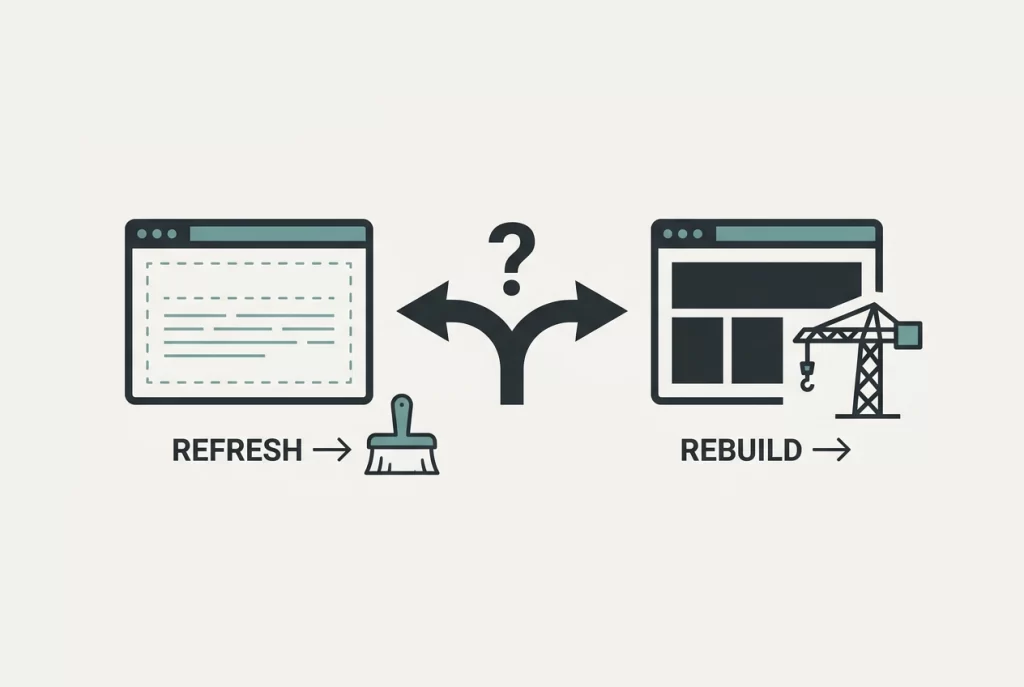
A refresh keeps your existing platform and hosting and reworks the pages that actually bring in enquiries: your homepage, your service pages and your contact details.
A rebuild replaces the foundation itself: the platform your site sits on, how the pages are structured, how fast it loads, and the look on top.
Here’s the honest trade-off. A refresh is faster and cheaper upfront, but it can’t fix a slow, structurally messy site. A rebuild costs more and takes longer, but it stops you paying to patch the same problem twice.
This is a decision article, so we should be straight with you: the tests in the next section are our own framework, built from evidence we can point to, not a finding from the ABS or an industry body.
By the end, you’ll have answers to three questions: does my small business website need a redesign, does it need brand new small business website designs from scratch, and where do I find good website design near me without the big corporate price tag.
Let’s get into it.
Our Five-Minute Test: Does Your Site Need a Refresh or a Rebuild?
These five tests take five minutes, from cited evidence and local client experience, not a published study.
Test 1, the speed test. Open a service page on your phone on mobile data, not office wifi. If words are fine but useful content is slow, speed is the problem, and it lives in the build, not the copy. Google’s Core Web Vitals measure how quickly your page shows useful content (LCP), how fast it responds when someone taps (INP), and how much it jumps around while loading (CLS). Google Search Console’s free report shows how real visitors experience all three, and PageSpeed Insights or Lighthouse can test a single page. If you’re failing those with decent hosting, read why your small business website needs to load fast on mobile.
Test 2, the editing test. Try updating a price, swapping a photo or adding a service without a developer. If every tiny edit becomes a project, the platform is the bottleneck and that is rebuild territory.
Test 3, the content test. Read your top three pages. Do they say what you do, who for, roughly what it costs, and how to get in touch? If missing or buried, that is refresh territory. We look for this with local clients.
Test 4, the growth test. What do you need next? Booking, online payments, several locations, or a structure per service. If your setup cannot do those, no new copy gets you there.
Test 5, the trust test. Look for real reviews, before and after examples, guarantees, real names and photos, and an easy-to-find phone number or form. Gaps are almost always fixable in a refresh, which is why we treat trust, contact and service-page content as the real conversion drivers.
Score honestly. Three or more tests pointing at platform, speed or structure means a rebuild is probably cheaper long-run. Most pointing at content and trust means a refresh will do.
What a Content and Conversion Refresh Actually Demands
If your site passed the speed and editing tests but failed on content and trust, a refresh is likely your lane. It usually covers a rewritten homepage, tightened service pages, clearer calls to action, updated contact details and hours, reviews and testimonials in visible spots, better photos, simpler enquiry forms, and the page titles and descriptions that show up in Google results. While you’re at it, our guide to what to post on social media when you have no ideas can help. In short, it’s about closing the trust and contact gaps Test 5 flagged.
Time is usually weeks rather than months. The biggest chunk isn’t design hours, it’s your own time supplying details, approving copy and confirming photos and prices. Cost is mainly content and design hours. There’s no platform migration, no URL mapping, no template rebuild, and little risk of the site disappearing from search results. We won’t quote a dollar figure because no credible source supports one.
You’re in refresh territory if your site loads acceptably on mobile, you can make basic edits, enquiries do come from service pages, and your pages are thin, dated or unclear about pricing and contact.
What a Full Rebuild Really Asks of You in Time and Money
Compared to a refresh, a rebuild replaces the platform your site sits on, hosting, page structure and URLs, templates, performance layer, and integrations like booking, payments or a customer database. It is a new building, not a new coat of paint.
On time, include a content audit, decisions on what stays or goes, building and testing, and redirect planning so old links land sensibly. Quotes often understate your availability for approvals: your evenings, not theirs.
Money comes in categories: design and build, migration and redirect setup, testing, possibly new hosting or licence fees. Our research found no verified public figure for a small business rebuild in Australia, so treat hard numbers with suspicion. Price drivers are page count, content volume and number of integrations. For a plain-English guide to pricing, see how much a small business website actually costs in Australia.
Risks are real but manageable. Rankings can dip if URL mapping and redirects are skipped, site moves can take months to settle, downtime needs planning, and you must learn a new editor. A rebuild is sensible and well-understood when the foundation is the actual problem.
The upside: clear the ceiling you have been bumping into, get a platform you can grow into, and stop paying maintenance on a system holding you back.
Three Signs a Rebuild Is the Cheaper Long-Run Decision
So you’ve priced the rebuild. Now, is your current site worth saving? These are our tests, not a published study.
Signal one: the platform has run out of road. If nobody supports your system, your developer warns you not to update it, or it can’t handle payments, bookings or multiple locations, a refresh just polishes a dead end.
Signal two: speed is baked into the build. In plain terms, how long until the page shows something useful, how fast it responds when someone taps, and how much it jumps around while loading. Google Search Console’s free Core Web Vitals report shows how real visitors experience all three, and PageSpeed Insights or Lighthouse can test a single page. Fail those on decent hosting with a sensible theme and the build is the problem, not your photos. Why Your Small Business Website Needs to Load Fast on Mobile explains more.
Signal three: the structure works against you. Service pages buried four clicks deep, no clear homepage hierarchy, competing pages, messy URLs, or nothing that tells Google what you offer. The ABS ‘Characteristics of Australian Business, 2024-25’ release covers internet connectivity and ICT use, but check the live figures.
Our reasoning, not a measured stat: delay stacks patch fees, plugin and security upkeep, and enquiries lost when slow pages get abandoned. The tipping test: if repair quotes come close to a clean build, start clean and stop paying for the same problem in instalments.
Refresh vs Rebuild Side by Side
So if the signals above point at platform, speed or structure, here is the side-by-side. This table is our framework, not a published study, and costs are types of expense rather than dollar figures because no credible Australian source backs a hard number.
| Refresh | Rebuild | |
|---|---|---|
| Cost type | Copy, photos, targeted fixes | Design, build, migration, redirects |
| Time | Weeks | Months |
| Risk | Low | Higher (migration, redirects) |
| Search visibility | Usually kept if URLs stay | Can dip if redirects slip |
| Your time | Moderate | High |
| Choose if | Content and contact are the problem | Platform, speed or structure is the blocker |
There is no universal winner, only the option that matches the tests you failed, which is exactly what the five-minute test was for.
For most local businesses, refreshing first and putting the savings into content, local advertising or your Google Business Profile earns more, sooner. Revisit a rebuild when revenue or growth actually demands it. If you are weighing up whether to DIY your website or hire a designer, that trade-off matters here too.
The trap? A rebuild sold as a new look that leaves thin service pages, hidden contact details and missing trust signals exactly where they were. If content problems survive the rebuild, the money went on the wrong thing.
Finding Website Design Near Me Without the Big-Agency Price Tag
So once you know which path you are on, the next question is who does the work.
When you search for website design near me, look for someone who understands how locals search, works with your Google Business Profile, and has a portfolio of small, locally based businesses rather than only big corporate sites.
Ask five questions before you sign: how much content and input do you need from me, who writes the words, what happens to my existing URLs and redirects, who owns the domain and site at the end, and can I edit it myself afterwards? Good operators answer all five without flinching.
Get a written scope listing the pages, revision rounds and expected timeline, so a refresh quote and a rebuild quote are judged on the same definition of done. That is not intimidating, it is just fair.
Red flags include a jargon-heavy quote with no plain English, no mention of redirects or page speed, no examples of local work, or a hard sell on a full rebuild before anyone has read your current content.
Local help is one option worth weighing. Epik Monkey works with small to medium, locally based businesses on website design, social media content, online advertising and graphic design, without the jargon or big corporate price tag. You can get to know Epik Monkey and judge it against the questions above. No pressure, just compare like for like.
Your Next Three Moves
If the five tests pointed mostly at content and trust, a refresh is likely your lane. If you’ve sorted a local partner and a written scope, here’s how to decide.
Action one: right now, open three service pages on your phone using mobile data. Rate each on load speed, how clearly it says what you do and roughly what it costs, and how easy you are to contact. Write your scores down. For a sense of what customers actually look for, our checklist of what a small business website should include helps you judge honestly.
Action two: run the five tests and count how many point at platform, speed or structure. Three or more means price a rebuild properly. Fewer means a refresh will likely earn its keep first.
Action three: get both options quoted against the same written scope, covering pages, revisions and timeline. That way you’re comparing like with like, not a number against a vague promise.
Still unsure? Get in touch and we’ll tell you honestly whether you need a refresh, a rebuild, or nothing much at all.
Conclusion
Choosing between a refresh and a rebuild comes down to what’s actually holding your site back. Remember the main takeaways: most local sites aren’t broken, just unclear, and trust, contact and service-page content often fix the problem; a rebuild only earns its money when platform, speed or structure is the real blocker; and comparing quotes against one written scope is the only fair way to judge price.
Your next step is simple. Run the three moves above, starting with three service pages on your phone, then get in touch with Epik Monkey for an honest read on which path suits you. No pressure, no jargon, just a straight answer on whether you need a refresh, a rebuild, or nothing much at all.
Your website should work as hard as you do, so start with one honest look at it today.