
You’ve just posted a great update, you got a handful of likes, maybe a new follower or two. But then you’re left staring at your phone wondering, is any of this actually doing anything for my business? It’s a question almost every local business owner asks about their social media marketing. And honestly, it’s the right question to ask.
The truth is, likes and follower counts don’t pay the rent. For a local business, social media is “working” when it leads to messages, calls, bookings and enquiries, the real signs that someone wants to buy from you. In this post, we’ll move past the vanity metrics and get practical. We’ll look at what working actually means, the five numbers worth tracking each month, why phone calls deserve a spot on your scorecard, how to set up simple attribution, and how to build a monthly scorecard you can actually stick to. We’ll also cover how to read those numbers (keep going, adjust, or change tack?) and the common traps that can make your data lie to you. By the end, you’ll have a clear, evidence-based way to judge whether your social media marketing is pulling its weight, and a few simple steps you can take this week.
Likes Don’t Pay the Rent: What Working Actually Means
You’ve felt this. A post collects hundreds of likes and not one enquiry. A plain little post about a cancelled appointment quietly brings in three bookings. Reach feels like progress, but it’s a means to an end, not the end itself.
A local business needs something narrower from social media than a national brand does. You don’t need to go viral in Sydney if your customers are in Ballarat. Your job is to be remembered and trusted by people who can physically get to you, then make it easy for them to call, message or book. Not every platform earns that place, which is why choosing the right channels comes before worrying about numbers.
Here’s the one-line test: did this month’s content produce an actual contact from someone who could reasonably buy from you?
The audience is there. The 2018 Yellow Social Media Report found 79% of Australians used social media, and 35% checked it more than five times a day, up from 26%. That’s 2018 data, used for context rather than as a current figure, but it confirms the eyeballs exist.
The rest of this article replaces “I feel like it’s not working” with four or five numbers you can compare month to month. No jargon required.
The Five Numbers Worth Tracking Each Month
Here is the shortlist. Not twenty metrics, not a dashboard, just five.
- Enquiries and messages. Count every genuine DM on Facebook and Instagram (including message requests), plus website contact forms and texts. Note how quickly you replied, because speed is often what turns a question into a booking.
- Inbound calls. The total, plus a rough split between new enquiries and existing customers if you can manage it. Calls are usually the biggest hole in a local scorecard simply because nobody writes them down.
- Bookings or jobs won. Appointments made, quotes accepted, orders placed, tables reserved. Pick one clear definition and stick to it. This is the number closest to money, so it deserves the tightest wording.
- Saves and profile visits. Softer signals that people are considering you. There is no reliable industry benchmark for these, so track your own trend rather than comparing yourself to someone else’s screenshot.
- One revenue-adjacent number. Average job value, quote-to-booking rate, or the count of new customers you can actually name. Choose whichever matches how money reaches your business.
Four or five is plenty. If a number would not change a decision you would make, cut it. The scorecard has to survive your busy months, not look impressive. If you are still working out what to post in the first place, our guide to building a social media content calendar your local business will actually stick to keeps that side of things simple.
One last thing: “good” means your own last three months, not someone else’s numbers. A small rise on your baseline beats a big number you cannot explain.
Why Calls Deserve a Spot on the Scorecard
Calls are often the number local businesses forget to log, which is a shame, because the data suggests they’re worth watching closely.
AutoReception’s 2026 analysis of 2,098 inbound calls across 27 Australian small businesses found 44.1% of conversations were potential new work, meaning a booking, quote or new enquiry. Only 1.1% were spam or sales calls.
Be aware of the caveat: that’s one AI receptionist vendor analysing its own customer base of 27 businesses, published in October 2026. It’s a good reason to count your calls, not a national benchmark to hold yourself against.
Here’s the bigger blind spot. In that sample, 26.5% of calls arrived outside 9am to 5pm on weekdays. After-hours conversations were actually more likely to be new business at 53.6%, compared with 42.4% during business hours. A scorecard that only counts business-hours calls undercounts real demand.
The timing peaks are practical too. Monday took 23.5% of weekly calls and 9am was the busiest hour at 12.0%. That’s useful when you’re testing posting times and deciding how fast to follow up.
The takeaway: if most of your customers phone you, calls belong on the scorecard even though they’re harder to attribute than a DM. A missed call you never recorded is a number you cannot improve. Getting your website to encourage those calls is part of the job, and our checklist for what a small business website should include covers exactly that.
Setting Up Simple Attribution for Your Social Media Campaign
Now you need to know which channels produce those calls and messages. You don’t need a complicated setup. Start free: ask. Add “How did you hear about us?” to your enquiry form, booking flow, and in-person script, then write the answers somewhere you’ll find them. Keep it specific: “Was it Instagram, Facebook, Google, or someone told you?” gives cleaner data than an open “where did you find us?”
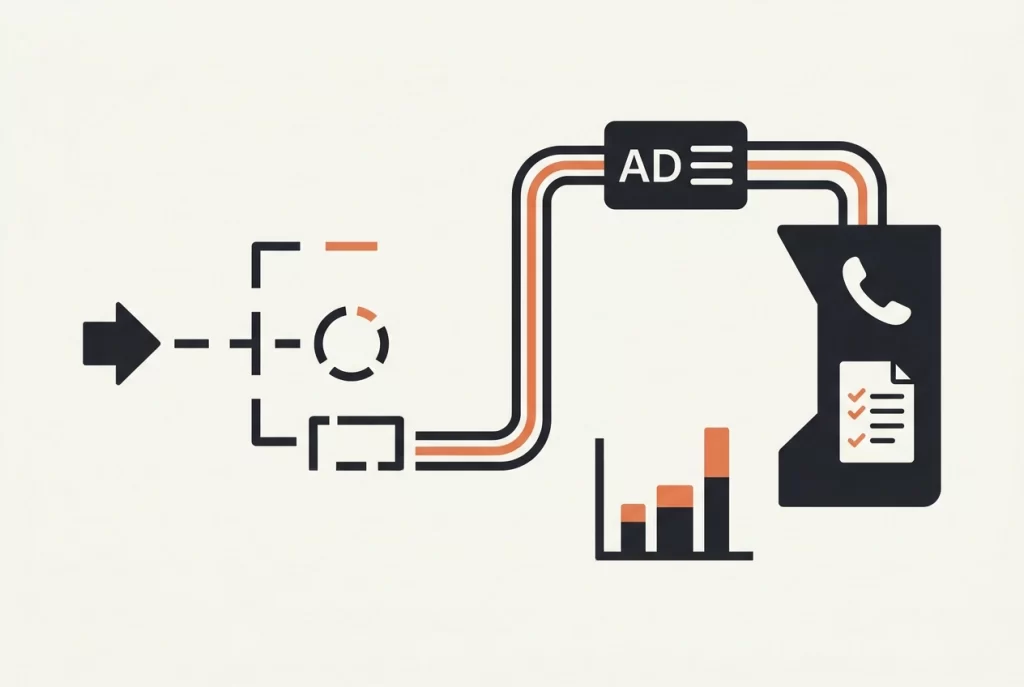
For calls, use a dedicated number on your social profiles, like a second mobile or tracking number, so calls from those channels stand out.
Give each social campaign one destination: a landing page, booking link, or keyword like “mention this post.” That is enough attribution for most local businesses without fancy software. If weighing paid options, our guide on Facebook Ads vs Google Ads for Local Australian Businesses helps you pick a starting point before you spend a cent.
Accept the fuzz. Someone might see three posts, ask a friend, then ring from a Google search. Perfect attribution isn’t the goal; rough direction is. If social is consistently mentioned in a third of new enquiries, that tells you plenty.
Avoid over-engineering early. A spreadsheet column and a habit of asking beat an analytics setup you never log into. If stuck on what to post while tracking this, our content framework for local Australian businesses gives a repeatable structure.
Building Your Monthly Scorecard
Once attribution is sorted, put it somewhere consistent. One spreadsheet is enough: a row per month, a column per number, and a notes column. Realistically, setup is a one-off job and the monthly update is a few minutes; the exact time matters less than the habit.
Before you count anything, fix your definitions. Decide what counts as an enquiry, include after-hours calls (they matter, given that 26.5% figure), and say whether repeat customers get their own line. If you’re also weighing paid search alongside social, our guide to Google Ads for local businesses helps you compare budgets and timelines properly.
Capture as you go. A note on your phone, a Friday diary entry, or a quick scroll through messages beats trying to remember a month later.
Add two context columns: roughly what you posted, including any paid promotion, and anything unusual, such as holidays, a big job that ate your week, or a broken website form. Date every row so you know what you’re comparing against, and keep the oldest rows. Your first three months become the baseline.
Finally, resist adding new metrics mid-year. If you must add one, start a fresh column and accept that its first month has no comparison point.
Reading the Scorecard: Keep Going, Adjust, or Change Tack
Look at a rolling three months, not a single one. One quiet month is noise. Three flat months is a pattern worth acting on, so compare this month with the two before it before you decide anything.
If contacts and bookings are steady or rising, keep going. Repeat what worked. Scroll back through the month and note which posts produced the messages, then make more of those.
If saves and profile visits are rising but enquiries are flat, people are interested but not being asked clearly enough. Add a plainer call to action, some price guidance, or a booking link in the caption. Make the next step obvious.
If everything is flat or falling across three months, change one variable at a time: format, offer, or posting times. The Monday and 9am call peaks from earlier are a reasonable starting point for testing when your audience is most reachable. Change only one thing so you know what caused the shift.
If you are spending more time building the scorecard than doing the work it measures, that is a signal in itself. It might be time to read about the signs it’s time to stop doing it yourself. Epik Monkey’s social media content, online advertising and end-to-end digital marketing services are built for local businesses that want the content handled while they get on with the job.
Write down your decision for the month, even if it is “change nothing”. Decisions made on evidence are easier to defend next quarter than decisions made on mood.
Common Traps That Make the Numbers Lie
Now that you have made a decision for the month, watch for the traps that make a clean scorecard tell fibs.
Vanity metrics at the top. Followers and reach can climb while enquiries fall. Keep them in the notes, never as the headline. If your followers double and your DMs halve, the scorecard is telling you something.
Judging one post. One flat video proves almost nothing. Give each format a fair month before you decide to drop it, and compare it with other attempts at the same format.
Ignoring seasonality. A café in January and a tradie in December are not comparable months. Compare year on year once you have the history, and note anything unusual while you build it.
Waiting for a perfect start. Begin now, even mid-month. A half-filled first row beats a pristine spreadsheet you never open. Capture what you can remember, then improve next month.
Over-tracking. Twenty metrics will be abandoned by month two, so keep to the four or five on your shortlist.
Counting only business-hours contacts. Keep enquiries and bookings separate: an enquiry is interest, a booking is money. And as the after-hours call numbers showed earlier, office-hours-only tracking misses real demand.
Avoid these traps and your scorecard stays honest enough to trust.
Your Next Steps This Week
The traps are easy to spot once you have numbers in front of you. Here is how to get started without overthinking it.
- Pick your four or five numbers today. Write down exactly what each one means for your business. If an enquiry must come with a phone number to count, say so now, so there is no debating it later.
- Add one attribution question to your enquiry form, something like “How did you hear about us?” Then pop a dedicated number on your social profiles so those calls are easy to spot.
- Start a spreadsheet with a single row for this month. A half-filled row still counts, as we saw above, so begin today even if the month is nearly done.
- Give it three months before you judge it. If messages, calls and bookings are trending up, your social media marketing is working. You can prove it with numbers rather than a feeling.
If you would rather spend that time on the tools or the counter, Epik Monkey can look after the content and the tracking, so you still own the numbers.
Conclusion
Tracking your social media shouldn’t feel like a second job. The key takeaways are simple: focus on four or five metrics that actually reflect business growth, keep enquiries and bookings separate, and make sure your calls are counted even when they come in after hours. Set up simple attribution now so you aren’t guessing later, and give your efforts a fair three-month window before you judge the results.
If time is tight, Epik Monkey can handle the content and the tracking while you stay focused on running your business. You still own the numbers and the decisions they inform.
Start that spreadsheet today. One row is all it takes to begin turning guesswork into confidence.